Intelligence for the
science of life.
InThoth searches the literature, analyzes and computes your data, supports research, and optimizes CMC process development. From the first question to the final process.
One agent. Four domains.
Thoth's four domains map, almost one to one, onto what every scientist still does each day: knowledge retrieval, data analysis and computation, research support, and CMC process development.
InThoth
From the first question to the final process.
- Knowledge — literature and knowledge retrieval, answers with sources
- Reckoning — data analysis and computation, from raw data to models and insight
- Science — research support across experimental design, analysis, interpretation
- Record — CMC process development, DoE, and auditable process records
- Grounded in real instrument data — FPLC to Q-ToF, screening to commercial scale
- In-region compliant compute · sensitivity-routed · 21 CFR Part 11-ready
Six capability domains, from target to process.
Every line maps to something the platform can actually run.
Targets & literature
Get the evidence straight before designing anything.
- Target assessment · multi-axis scoring with a go / no-go call
- Deep research · multi-step retrieval and cross-checking
- Literature review · structured synthesis with citations
- Indication dossier · competitive landscape and clinical progress
- Regulatory mapping · FDA / NMPA / EMA / PMDA differences
Structure & molecular design
Not a description of the method — the computation actually runs.
- Protein folding and complex co-folding
- De novo binder scaffolds · antibody CDR design
- Inverse-folding sequence design (ligand / nucleic-acid aware)
- Docking · binding free energy (fast ranking and high-accuracy tiers)
- Outputs are stored and rendered as interactive 3D, with provenance captured
Nucleic acids & delivery
Modality-aware design, with hard gates up front.
- ASO / siRNA candidate design and ranking
- Thermodynamics and secondary-structure accessibility (real MFE)
- Off-target screening across the transcriptome
- Chemistry modification advice — evidence-table driven, silent when there is none
- Controlled-sequence screening is a hard gate, not a warning
- Oligonucleotide synthesis process development — design and synthesis on one thread
CMC process
The flagship — nine years of instrument and process experience, productized.
- Process-development assistant · capture / polish / viral / final, end to end
- DoE design·run·analysis — Gaussian process + Bayesian optimization picks the next runs
- Chromatography-column catalog and remaining column lifetime
- Process records · cross-batch CQA trends and root-cause location
- Impurity attribution with characterization methods and proposed limits
- Peptide synthesis process development — from route to purification and characterization
Regulatory & documents
The deliverable is a document you can file, not a chat log.
- Risk assessment · FMEA templates with AI fill
- ICH Q9 / QbD design space and CPP–CQA mapping
- IND / NDA report drafts · FDA / NMPA style-matched
- Development report · process description · specification drafting
- Publication-ready figures and slides that go straight into a review
Compliance & compute
Not a line item — a constraint that runs through the whole path.
- Four sensitivity levels: public / internal / sensitive / confidential
- Sensitive and confidential run in-region only — no compliant option means refusal, not fallback
- Any provider without a declared residency is treated as overseas
- Code executes in an isolated sandbox; no outbound traffic in private deployment
- Audit trail · 21 CFR Part 11 electronic records and signatures
Built like infrastructure. Used like a product.
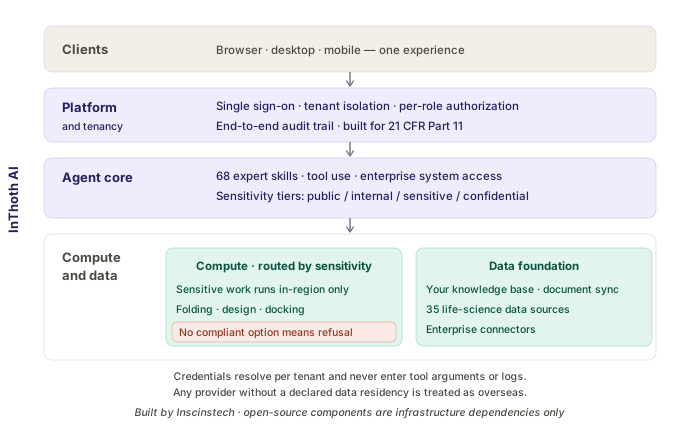
Four layers: from browser and desktop clients, through platform access and tenancy, the agent core and its sensitivity tiers, down to in-region compute and the data foundation.
Platform access
Single sign-on · tenant and role isolation · end-to-end audit trail · built for 21 CFR Part 11.
Agent core
68 expert skills · tool use · enterprise system access · sensitivity tiering.
Compute & data
Sensitive and confidential work runs in-region only; with no compliant option the task is refused, not downgraded · 35 life-science data sources.
35 life-science data sources, broken down by category.
"Connected to data sources" should come with a number. Below is how many sources each category carries, with a few representative names. All are read-only — we pull from them and never push your data back. The full list is available on request.
Proteins & structures
- UniProt
- RCSB PDB
- AlphaFold DB
- and 3 more
Compounds & pharmacology
- PubChem
- ChEMBL
- BindingDB
- and 4 more
Genomics, variants & expression
- Ensembl
- gnomAD
- ClinVar
- and 5 more
Targets, pathways & ontologies
- Open Targets
- STRING
- Reactome
- and 1 more
Literature, trials, regulatory & patents
- PubMed
- ClinicalTrials.gov
- openFDA
- and 5 more
Domestic sources
- iProX (proteomics)
- NGDC / CNCB (genomics)
Enterprise connectors (WeCom · DingTalk · Feishu · read-only database · generic REST · Git · SLURM · SDS/EHS) and document-source sync (local directories · ELN/LIMS · ADCDB · PROTAC-DB and others) exist alongside these. Credentials resolve per tenant from a secret store and never enter tool arguments or logs.
In sensitive and confidential sessions, overseas data sources and overseas MCP servers are disabled outright.
We don't just build the software. We build the instruments.
Three moats a software-only player cannot copy.
Real instrument data
Most AI reads text off the web. InThoth is grounded in the real wet-lab and process data generated across Inscinstech's instrument portfolio — it reasons about the experiment and the process, not just language.
Across every scale
Continuous, same-source data from high-throughput screening to commercial manufacturing — so scale-up is predicted from data instead of discovered by trial and error at the cliff edge.
Insight → instrument loop
Process development and analytics in equal measure: FPLC, TFF, chromatography, bioreactors, HPLC, capillary electrophoresis, LC-MS through Q-ToF — a designed process can run on the metal.
We don't just build the software. We build the instruments the science runs on.
Most AI reads text off the web. InThoth is grounded in the real wet-lab and process data generated across Inscinstech’s instrument portfolio — process development and analytics in equal measure, across every scale.
Process development
- Oligonucleotide synthesis
- Peptide synthesis
- Bioreactor / fermentation
- FPLC protein purification
- TFF tangential-flow process development
- Chromatography process development
Analytics
- HPLC analysis
- Capillary electrophoresis (CE)
- LC-MS (single quadrupole)
- LC-MS/MS (triple quadrupole)
- LC-MS/MS (Q-ToF tandem MS)
Every scale
- Screening
- Bench
- Pilot
- Commercial
Insight → instrument → better data → better insight
Which enables five things a software-only AI cannot do
Scale-up prediction
Real data at every scale predicts which parameters survive scale-up and which break — you cross the scale-up cliff on data, not on trial and error.
A single process thread
One queryable thread from screening to commercial — no data gaps between stages, and tech-transfer packages in minutes.
Manufacturability, early
Pick the most scalable route while still screening, so candidates that cannot scale die cheap instead of late.
Fewest runs at every scale
Pilot and commercial batches are expensive — DoE plus surrogate models drive the number of runs down at every scale.
Design space & robustness
Define the design space and map CPPs to CQAs, locking batch-to-batch consistency before commercial (QbD / ICH Q8).
Other AI stops at the bench. InThoth follows your process all the way to commercial — because Inscinstech’s instruments do too.
Ship better CMC. Faster. With AI that knows the field.
Start free, no credit card. Upgrade to Plus / Pro / Max any time.